
- VIAC
-
ARBITRATION
- Arbitrate at VIAC
- VIAC eCase
- Combination of Arbitration and Mediation
- International Arbitration
- Resources
- NEWS & EVENTS
- Contact
-




On the evening of August 20, 2026, as part of the Ho Chi Minh City Legal Management Series 2026 (LMS 2026), the talkshow on "Commercial contracts with counterpart clauses – Streamlining contract formation or increasing legal risks?", co-organized by the Vietnam International Arbitration Centre (VIAC) in collaboration with the Ho Chi Minh City Investment and Trade Promotion Centre (ITPC), garnered the virtual attendance of nearly 150 delegates.
The talkshow was moderated by Mr. Quach Minh Tri – Partner at BMVN International LLC, VIAC’s Arbitrator, featuring the participation of panelists: Mr. Bui Van Thanh - Director of New Sun Law Firm, VIAC’s Arbitrator, VMC’s Mediator; and Mr. Pham Quoc Tuan - Managing Partner at DIMAC Law Firm, VIAC’s Arbitrator, VMC’s Mediator.
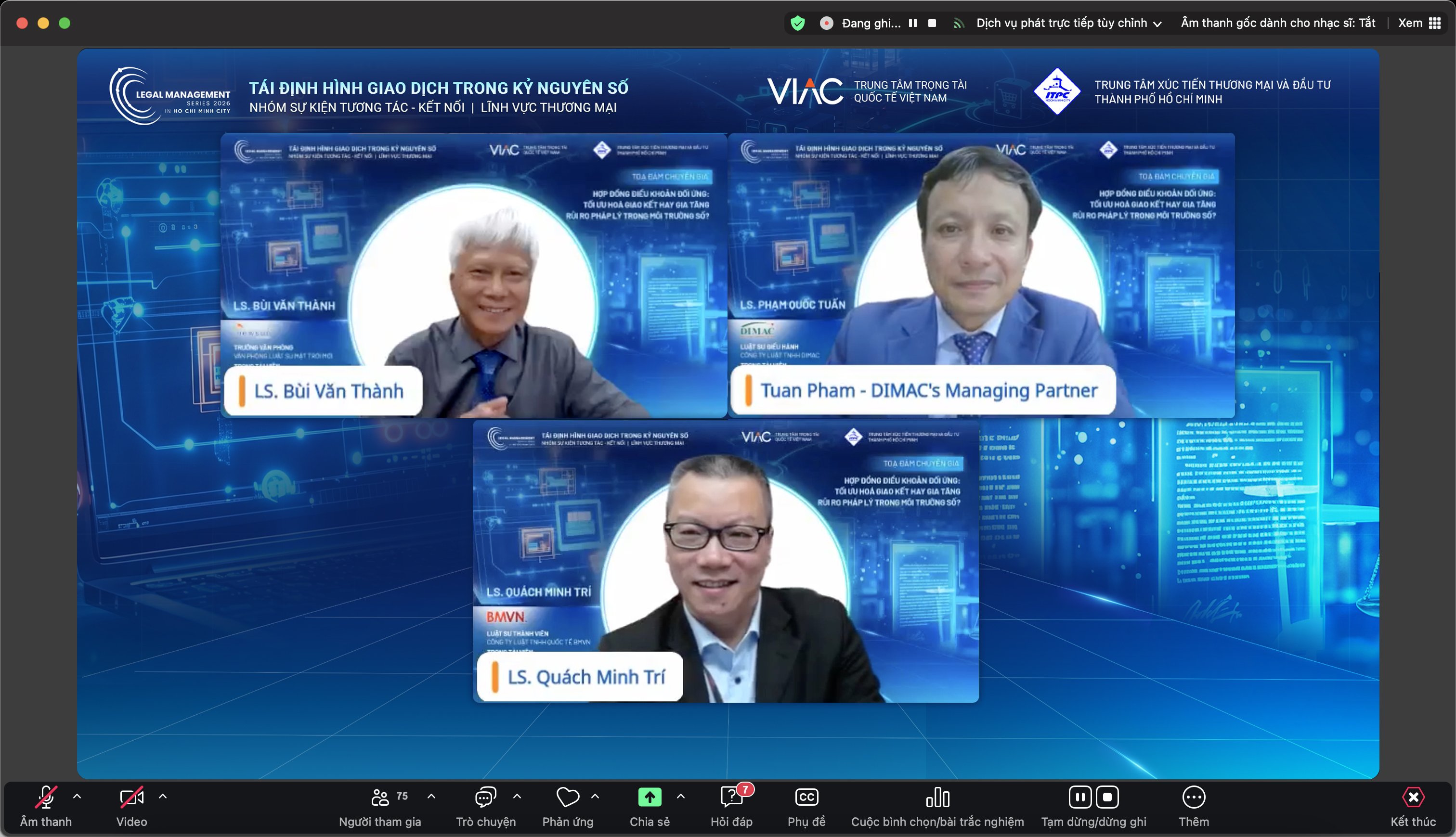
Commencing the Talkshow, Mr. Quach Minh Tri provided an overview of the mechanism of execution in counterparts and counterpart clauses within contract formation practice. This mechanism is particularly advantageous when the parties are situated in disparate geographical locations and are unable to concurrently execute a singular contract document. However, the application of this mechanism remains predicated on the principle of freedom of contract; consequently, in practice, provided that the prerequisites for mutual agreement are satisfied, contract formation via counterparts may still be legally recognized even in the absence of such an explicit clause within the contract.
In practice, executing contracts in counterparts entails considerable risks. Elaborating on this issue, Mr. Bui Van Thanh clarified that, as the parties are not required to concurrently execute a singular contract document, this method may give rise to disputes over the effective date of the contract. If the contract does not clearly specify, the parties may have different interpretations as to when their respective rights and obligations commence, the period for performance, notice periods, and other applicable time limits.
In addition, Mr. Pham Quoc Tuan noted that when each party signs a separate copy of the contract, risks may arise if the parties inadvertently sign different versions or if changes are made to the contract without the other party’s knowledge. This scenario is further complicated when the counterparts contain conflicting dispute resolution clauses. Under such circumstances, it must first be determined whether the parties have genuinely reached a mutual consensus to form a valid contract; concurrently, the validity and substance of the arbitration agreement must be independently examined in accordance with the separability of the arbitration agreement.
To mitigate disputes, the speakers provided several recommendations, notably emphasizing that counterpart clauses should be drafted in detail and that communication regarding the counterparts must remain seamless between the parties. Concurrently, the parties may designate the involvement of neutral third parties (e.g., legal or technological experts) to act as witnesses, as well as to verify, inspect, and archive the counterparts. Furthermore, drawing upon practical experience, the speakers cautioned that enterprises should communicate explicitly with foreign counterparties when executing transactions in counterparts, because of the disparities in contract formation practices across jurisdictions.
From a practical standpoint, within the contemporary context of business digitalization, numerous issues concerning paperwork, procedural hurdles, and the physical circulation of executed counterparts have been significantly mitigated. Currently, various technological solutions can assist in verifying and guaranteeing the integrity of contracts jointly executed by the parties; consequently, contract execution on digital platforms and the utilization of electronic signatures, particularly digital signatures, are increasingly demonstrating advantages in terms of convenience, expediency, and the capacity to oversee the execution process. Against this backdrop, enterprises may reevaluate the role of counterpart clauses in their contracts and determine the most optimal contract formation mechanisms for their operations, balancing these against the type of business, sector, or legal requirements governing their contracts and transactions.
Following the expert discussions, the talkshow proceeded with a Q&A, open discussion and information exchange session between the speakers and the attendees. Through addressing questions, the speakers further clarified the advantages and legal risks that merit consideration when utilizing the countersignature, thereby underscoring the necessity of selecting an appropriate contract formation mechanism and proactively overseeing the contractual performance process within the context of digitalization.
▶️ Watch the program again here: https://www.youtube.com/watch?v=JPxz500dhNY


![[Recap LMS 2026] Business Legal Lens (BLL) #02: “Force majeure: The gap between business understanding and legal approach”](/images/News-and-Events/2026/News/LMS 2026/BLL02/IMG_0136.jpg)
![[Recap LMS 2026] VIAC & ITPC co-organized the Business Legal Lens (BLL) #01: “Conditions precedent in loan agreements: Understanding correctly to prevent risks”](/images/News-and-Events/2026/News/LMS 2026/BLL 01/IMG_8873.jpg)
![[Recap LMS 2026] Talkshow “Exemption from liability for technology-related risks in logistics transactions”](/images/News-and-Events/2026/News/LMS 2026/Logistics/LMS2026_2708---Slideshow-1.jpg)
![[Recap LMS 2026] Talkshow “Arbitral jurisdiction in resolving disputes arising from digital financial transactions"](/images/News-and-Events/2026/News/LMS 2026/Tai chinh/LMS2026_260813__Backdrop.png)



.png "Trường đại học ngoại thương")